J Dent Res Dent Clin Dent Prospects. 20(1):32-35.
doi: 10.34172/joddd.44130
Original Article
Exploring BMI and DMFT Indexes of Male Islamic Boarding School Students in Indonesia: A Cross-Sectional Study
Laifa Annisa Hendarmin Conceptualization, Data curation, Methodology, Project administration, Supervision, Validation, Writing – review & editing, 1, * 
Muhammad Faiza Ma'ruf Data curation, Methodology, Validation, Writing – review & editing, 2
Risahmawati Risahmawati Data curation, Methodology, Validation, Writing – review & editing, 3
Witri Ardini Data curation, Methodology, Validation, Writing – review & editing, 4
Sarah At Tauhidah Data curation, Methodology, Validation, Writing – review & editing, 3
Author information:
1Department of Medical Biology, Faculty of Medicine, Universitas Islam Negeri Syarif Hidayatullah Jakarta, Banten, Indonesia
2Faculty of Medicine, Universitas Islam Negeri Syarif Hidayatullah Jakarta, Banten, Indonesia
3Department of Community Medicine, Faculty of Medicine, Universitas Islam Negeri Syarif Hidayatullah Jakarta, Banten, Indonesia
4Department of Clinical Nutrition, Faculty of Medicine, Universitas Islam Negeri Syarif Hidayatullah Jakarta, Banten, Indonesia
Abstract
Introduction:
Adolescent health reflects both nutritional and oral conditions, which share dietary and behavioral risk factors. In Muslim societies, Islamic boarding schools (pesantren) shape adolescent lifestyles through communal meals, structured routines, and religious values of cleanliness. Their students, called santri, represent a unique adolescent population. This study examined the relationship between the body mass index (BMI) and dental caries experience, measured by the decayed, missing, and filled teeth (DMFT) index, among male santri in Indonesia.
Methods:
A cross-sectional study was conducted in 2024 among 85 male santri at an Islamic boarding school in Bogor, Indonesia. BMI was classified according to CDC-2000 growth charts. Dental caries experience was assessed using the WHO DMFT index. Descriptive statistics summarized BMI and DMFT distributions. Associations were evaluated using the chi-squared or Fisher’s exact test.
Results:
Most participants had normal BMI (65.9%), while 18.8% were overweight, and 10.6% were obese. Regarding oral health, 55.3% had very low DMFT scores, and 10.6% had high or very high caries experience. No significant association was observed between BMI and DMFT categories (P=0.276).
Conclusion:
Although no significant association was identified, the coexistence of obesity and high caries in a subset of santri indicates a dual public health concern. These findings warrant further investigation and highlight the need for preventive strategies addressing both nutrition and oral health in Islamic boarding school settings.
Keywords: Adolescent, Body mass index, DMFT index, Dental caries, Islamic boarding school, Students
Copyright and License Information
© 2026 The Author(s).
This is an open access article distributed under the terms of the Creative Commons Attribution License (
http://creativecommons.org/licenses/by/4.0/), which permits unrestricted use, distribution, and reproduction in any medium, provided the original work is properly cited.
Funding Statement
This research received no specific grant from any funding agency in the public, commercial, or not-for-profit sectors.
Introduction
Oral health is an integral component of general health and well-being. The World Health Organization (WHO) Global Oral Health Status Report (2022) highlighted that oral diseases, particularly dental caries, remain a major public health challenge worldwide, affecting more than 2 billion people, over one third of the global population.1 In Indonesia, the 2018 Basic Health Research Survey (Riskesdas) reported that 88.8% of the population had experienced dental caries, reflecting a very high national burden.2 Caries prevalence increases gradually from adolescence into adulthood, making early prevention a critical public health priority.3
The DMFT index is a standardized measure widely used in epidemiological studies to assess cumulative caries experience.4 Numerous studies have demonstrated that knowledge, behavior, and attitudes toward oral health influence DMFT outcomes.5-7 For example, Indonesian studies among university students and schoolchildren reported significant knowledge‒DMFT associations,7,8 and findings from Saudi Arabia further highlight how population-level factors relate to caries patterns.9
At the same time, nutritional status, often assessed using the body mass index (BMI), has been increasingly recognized as an important determinant of oral health. Both obesity and undernutrition share common dietary risk factors with dental caries, particularly excessive sugar consumption and poor diet quality.10 However, the relationship between BMI and caries remains inconsistent across studies and may be influenced by contextual and cultural factors, including hygiene practices, dietary environment, and access to care.11
In Muslim societies, Islamic boarding schools (pesantren) provide a unique living and learning environment where adolescents (santri) spend extended periods in communal settings. Their daily lives are shaped by structured routines, shared diets, and religious teachings emphasizing cleanliness (ṭ ahārah). These distinctive conditions may influence both nutritional status and oral health; yet, little is known about the interplay between BMI and dental caries in this population.
This study aimed to examine the relationship between BMI and DMFT index among male adolescents in an Islamic boarding school in Indonesia. By focusing on this under-researched population, the study provides insights into the dual public health challenges of nutrition and oral health in culturally specific educational settings.
Methods
Study Design and Participants
This cross-sectional study was conducted in 2024 among male students in an Islamic boarding school in Bogor, Indonesia. From an initial pool of 100 students, 85 met the inclusion criteria (adolescents aged 14‒17 years, free from systemic diseases affecting growth or oral health, and provided consent to participate). Exclusion criteria included incomplete data, systemic illness, or refusal to participate. A consecutive sampling approach was used. Only male students were included because male and female students in Islamic boarding schools live separately, with distinct environments and routines that could influence health behaviors.
Anthropometric Measurement
Body weight and height were measured using calibrated instruments. BMI was calculated as weight (kg) divided by height squared (m2) and categorized according to the CDC-2000 growth charts into underweight ( < 5th percentile), normal (5th‒85th percentile), overweight (85th‒95th percentile), and obese ( ≥ 95th percentile).12
Dental Examination
Oral examinations were performed by a trained dentist using disposable instruments under adequate light. Caries experience was assessed according to WHO criteria for the DMFT index.4 DMFT scores were further categorized into very low (0.0‒1.1), low (1.2‒2.6), moderate (2.7‒4.4), high (4.5‒6.5), and very high ( ≥ 6.6), based on WHO classification.4
Statistical Analysis
Data were analyzed using SPSS 24.0 (IBM Corp., Armonk, NY, USA). Descriptive statistics were presented as frequencies and percentages. Associations between BMI and DMFT categories were tested using the chi-squared/Fisher’s exact test, as appropriate. Statistical significance was set at P < 0.05.13
Results
Participant Characteristics
Eighty-five male students participated in the study (Table 1). The largest age group was 16 years (42.4%), followed by 15 years (35.3%), 17 years (20.0%), and 14 years (2.4%). Based on BMI, 65.9% were categorized as normal, 18.8% as overweight, 10.6% as obese, and 4.7% as underweight.
Table 1.
Demographic characteristics of participants (n = 85)
|
Variable
|
n
|
%
|
| Age (years) |
|
|
| 14 |
2 |
2.4 |
| 15 |
30 |
35.3 |
| 16 |
36 |
42.4 |
| 17 |
17 |
20.0 |
| BMI category |
|
|
| Underweight ( < 5th percentile) |
4 |
4.7 |
| Normal (5th–85th percentile) |
56 |
65.9 |
| Overweight (85th–95th percentile) |
16 |
18.8 |
| Obese ( ≥ 95th percentile) |
9 |
10.6 |
BMI categorized according to CDC-2000 growth charts.
Dental Caries Distribution
The majority of students (55.3%) had very low DMFT scores, followed by 15.3% with low, 15.3% with moderate, 7.1% with high, and 7.1% with very high DMFT scores (Table 2).
Table 2.
Distribution of DMFT scores among participants (n = 85)
|
DMFT Category
|
n
|
%
|
| Very low (0.0–1.1) |
47 |
55.3 |
| Low (1.2–2.6) |
13 |
15.3 |
| Moderate (2.7–4.4) |
13 |
15.3 |
| High (4.5–6.5) |
6 |
7.1 |
| Very high ( ≥ 6.6) |
6 |
7.1 |
DMFT categories based on WHO classification
Association between BMI and DMFT
Cross-tabulation showed that overweight and obese students tended to cluster in the very low and high DMFT categories; however, the association between BMI and DMFT was not statistically significant (P = 0.276) (Table 3, Figure 1).
Table 3.
Association between BMI and DMFT categories (n = 85)
|
BMI group
|
Very low n (%)
|
Low n (%)
|
Moderate n (%)
|
High n (%)
|
Very high n (%)
|
P
value*
|
| Underweight |
3 (75.0) |
0 (0) |
0 (0) |
0 (0) |
1 (25.0) |
0.276 |
| Normal |
26 (46.4) |
11 (19.6) |
11 (19.6) |
3 (5.4) |
5 (8.9) |
| Overweight |
11 (68.8) |
2 (12.5) |
2 (12.5) |
1 (6.3) |
0 (0) |
| Obese |
7 (77.8) |
0 (0) |
0 (0) |
2 (22.2) |
0 (0) |
Chi-squared/Fisher’s Exact test.
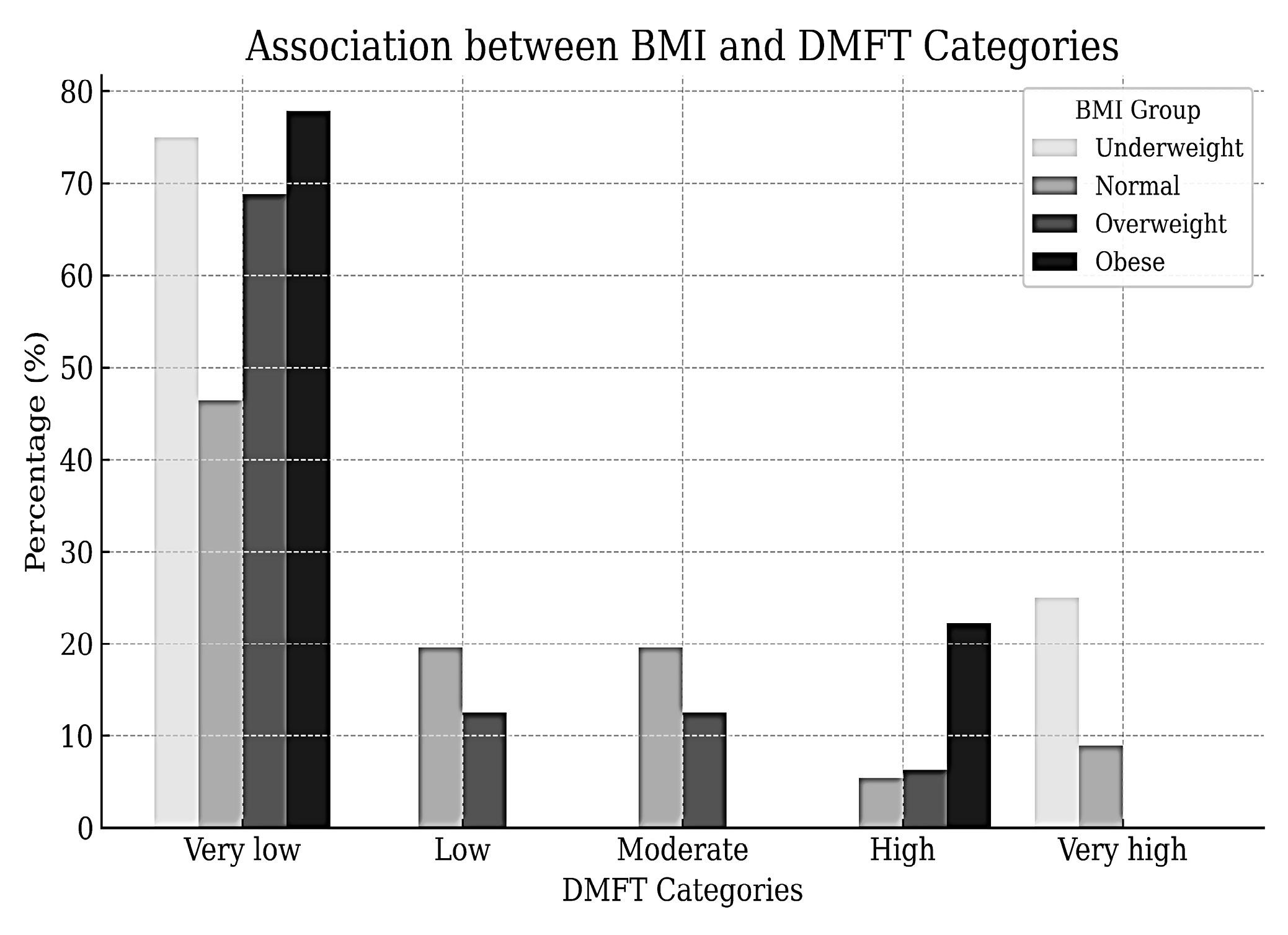
Figure 1.
Association between BMI and DMFT categories among adolescent male students at Islamic Boarding School (n = 85). Percentages within each BMI group are shown for five DMFT categories (very low, low, moderate, high, very high). No significant association was observed. (chi-squared test, P = 0.276).
.
Association between BMI and DMFT categories among adolescent male students at Islamic Boarding School (n = 85). Percentages within each BMI group are shown for five DMFT categories (very low, low, moderate, high, very high). No significant association was observed. (chi-squared test, P = 0.276).
Discussion
This study examined the relationship between BMI and dental caries experience (DMFT index) among male students in an Islamic boarding school in Indonesia. The majority of participants had a normal BMI, while approximately one-third were overweight or obese. More than half showed very low DMFT scores, although 10.6% presented with high or very high caries experience. There was no significant association between BMI and DMFT.
The absence of a significant relationship is consistent with findings from several previous studies. A systematic review by Paisi et al.14 reported that among higher-quality studies, most found no association between BMI and dental caries, although some observed positive correlations in older children. Likewise, a recent adolescent pilot study found that obesity defined by BMI was not associated with caries activity.15 Similarly, research among adolescents by Lopez del Valle et al.16 reported no association between BMI and caries.By contrast, population-based data from Ecuador suggested a more complex, non-linear BMI‒caries pattern without an overall significant association; potential behavioral and environmental influences warrant further studies.17
Other investigations further emphasize inconsistency. A meta-analysis by Hayden et al.11 highlighted significant heterogeneity across populations.Regional data also illustrate variability: research in Saudi Arabia showed differences in caries burden related to environmental context such as water fluoride levels,18 while school-based studies in other populations have reported positive BMI‒caries correlations.19,20 In addition, lifestyle and dietary risk exposures remain important correlates of caries: an analysis in Malaysian preschoolers showed associations with nutritional status, sugar intake, and second-hand smoke exposure.21
The relatively uniform environment of Islamic boarding schools may help explain the absence of a significant association in this study. Students typically share diets, routines, and hygiene practices, which could reduce variability in both BMI and DMFT outcomes. Nevertheless, the coexistence of obesity and high caries in a subset of students highlights the dual burden of malnutrition and oral disease in Indonesia.2 Poor dietary habits, particularly excessive sugar intake, contribute to both conditions and reinforce the need for integrated prevention.3,21
Gender-specific factors are also relevant. This study included only male students, reflecting the gender-segregated structure of many Islamic boarding schools. Female students often demonstrate more favorable oral hygiene behaviors, which may result in different caries outcomes.22,23 Focusing on a male-only sample reduced potential confounding due to gender-related behavioral differences, but future research should include female cohorts to provide a more comprehensive understanding.
Overall, these findings emphasize that the relationship between BMI and caries cannot be explained by nutritional status alone. Broader determinants including oral hygiene practices, dietary behaviors, and socio-environmental influences likely play an important role. Boarding schools, with their communal living and strong cultural values, present an opportunity for integrated interventions that combine nutrition education with oral health promotion, aligned with religious teachings on cleanliness and moderation.
Limitations
This study has several limitations. It was conducted in a single institution with a relatively small and homogenous sample, which may limit generalizability. The cross-sectional design precludes causal inference. Important confounders such as diet, oral hygiene practices, and socioeconomic background were not assessed. Furthermore, the DMFT index, while widely used in epidemiological surveys, does not distinguish between active and inactive caries or capture early enamel lesions, which may have led to underestimation of caries activity in the study population.
Conclusion
No significant association between BMI and DMFT was observed among male students in an Islamic boarding school in Indonesia. However, the coexistence of obesity and high caries among a subset of students reflects a dual public health concern. These findings highlight the importance of school-based programs that integrate balanced diet education with daily supervised toothbrushing and culturally tailored oral health promotion to improve adolescent well-being in boarding school settings.
Competing Interests
The authors declare no conflicts of interest related to this work.
Data Availability of Statement
The datasets generated and analyzed during the current study are available from the corresponding author upon reasonable request.
Ethical Approval
This study received approval from the Health Research Ethics Committee, Faculty of Medicine, Universitas Islam Negeri Syarif Hidayatullah Jakarta (No. B-040/F12/KEPK/TL.00/11/2024). Written informed consent was obtained from all participants and their guardians.
References
- World Health Organization. Global Oral Health Status Report: Towards Universal Health Coverage for Oral Health by 2030. Geneva: WHO; 2022. Available from: https://www.who.int/publications/i/item/9789240061484. Accessed October 14, 2025.
- Ministry of Health Republic of Indonesia. Basic Health Research (Riskesdas) 2018. Jakarta: National Institute of Health Research and Development; 2019. Available from: https://repository.badankebijakan.kemkes.go.id/id/eprint/3514/. Accessed October 14, 2025.
- Petersen PE. The World Oral Health Report 2003: continuous improvement of oral health in the 21st century--the approach of the WHO Global Oral Health Programme. Community Dent Oral Epidemiol 2003; 31 Suppl 1:3-23. doi: 10.1046/j..2003.com122 [Crossref] [ Google Scholar]
- World Health Organization. Oral Health Surveys: Basic Methods. 5th ed. Geneva: WHO; 2013. Available from: https://www.who.int/publications/i/item/9789241548649. Accessed October 14, 2025.
- Petersen PE, Kwan S. Equity, social determinants and public health programmes--the case of oral health. Community Dent Oral Epidemiol 2011; 39(6):481-7. doi: 10.1111/j.1600-0528.2011.00623.x [Crossref] [ Google Scholar]
- Rajab LD, Petersen PE, Bakaeen G, Hamdan MA. Oral health behaviour of schoolchildren and parents in Jordan. Int J Paediatr Dent 2002; 12(3):168-76. doi: 10.1046/j.1365-263x.2002.00359.x [Crossref] [ Google Scholar]
- Namira HM, Hatta I, Sari GD. Hubungan pengetahuan, sikap dan tindakan kesehatan gigi dan mulut terhadap tingkat kerusakan gigi pada siswa SMP. Dentino J Ked Gigi 2021; 5(1):47-51. doi: 10.20527/dentin.v5i1.3234 [Crossref] [ Google Scholar]
- Rahtyanti GC, Hadnyanawati H, Wulandari E. Correlation of oral health knowledge with dental caries in first grade dentistry students of Jember university academic year 2016/2017. e-Journal Pustaka Kesehatan 2018; 6(1):167-72. doi: 10.19184/pk.v6i1.7153 [Crossref] [ Google Scholar]
- Al Agili DE. A systematic review of population-based dental caries studies among children in Saudi Arabia. Saudi Dent J 2013; 25(1):3-11. doi: 10.1016/j.sdentj.2012.10.002 [Crossref] [ Google Scholar]
- Kantovitz KR, Pascon FM, Rontani RM, Gavião MB. Obesity and dental caries--a systematic review. Oral Health Prev Dent 2006; 4(2):137-44. doi: 10.3290/j.ohpd.a11200 [Crossref] [ Google Scholar]
- Hayden C, Bowler JO, Chambers S, Freeman R, Humphris G, Richards D. Obesity and dental caries in children: a systematic review and meta-analysis. Community Dent Oral Epidemiol 2013; 41(4):289-308. doi: 10.1111/cdoe.12014 [Crossref] [ Google Scholar]
- Kuczmarski RJ, Ogden CL, Guo SS, Grummer-Strawn LM, Flegal KM, Mei Z, et al. 2000 CDC Growth Charts for the United States: methods and development. Vital Health Stat 11 2002(246):1-190.
- Field A. Discovering Statistics Using IBM SPSS Statistics. 5th ed. London: Sage Publications; 2018. Available from: https://collegepublishing.sagepub.com/products/discovering-statistics-using-ibm-spss-statistics-5-260423. Accessed October 14, 2025.
- Paisi M, Kay E, Bennett C, Kaimi I, Witton R, Nelder R. Body mass index and dental caries in young people: a systematic review. BMC Pediatr 2019; 19(1):122. doi: 10.1186/s12887-019-1511-x [Crossref] [ Google Scholar]
- Awad M, Bani Issa W, Radwan H, Fakhry R, Al-Yateem N, Rossiter R. Association between obesity and dental caries among adolescents in UAE: a pilot cross sectional study. Front Oral Health 2023; 4:1160428. doi: 10.3389/froh.2023.1160428 [Crossref] [ Google Scholar]
- Lopez Del Valle LM, Nieves-Plaza M, Rivas-Tumanyan S, Hanke-Herrero R. Relationship between caries indexes and obesity in a sample of Puerto Rican adolescents. Front Dent Med 2024; 5:1391833. doi: 10.3389/fdmed.2024.1391833 [Crossref] [ Google Scholar]
- Villavicencio-Caparo E, Alvarracin-Duran AJ. Association between body mass index and decayed, missing, and filled teeth (DMFT) in 12-year-old school children. Open Dent J 2025; 19(1):e18742106364538. doi: 10.2174/0118742106364538250603052437 [Crossref] [ Google Scholar]
- Al Dosari AM, Wyne AH, Akpata ES, Khan NB. Caries prevalence and its relation to water fluoride levels among schoolchildren in central province of Saudi Arabia. Int Dent J 2004; 54(6):424-8. doi: 10.1111/j.1875-595X.2004.tb00299.x [Crossref] [ Google Scholar]
- Chen D, Zhi Q, Zhou Y, Tao Y, Wu L, Lin H. Association between dental caries and BMI in children: a systematic review and meta-analysis. Caries Res 2018; 52(3):230-45. doi: 10.1159/000484988 [Crossref] [ Google Scholar]
- Ghodke SS, Kalbage SH, Thakkar VP, Sevekar SA. Association of BMI with dental caries among children in tribal school of Shantivan, Nere, Maharashtra. World J Dent 2023; 14(10):913-7. doi: 10.5005/jp-journals-10015-2312 [Crossref] [ Google Scholar]
- Lee ZL, Gan WY, Lim PY, Hasan R, Lim SY. Associations of nutritional status, sugar and second-hand smoke exposure with dental caries among 3- to 6-year old Malaysian pre-schoolers: a cross-sectional study. BMC Oral Health 2020; 20(1):164. doi: 10.1186/s12903-020-01152-0 [Crossref] [ Google Scholar]
- Ferraro M, Vieira AR. Explaining gender differences in caries: a multifactorial approach to a multifactorial disease. Int J Dent 2010; 2010(1):649643. doi: 10.1155/2010/649643 [Crossref] [ Google Scholar]
- Sakki TK, Knuuttila MLE, Anttila SS. Lifestyle, gender and occupational status as determinants of dental health behavior. J Clin Periodontol 1998; 25(7):566-70. doi: 10.1111/j.1600-051X.1998.tb02489.x [Crossref] [ Google Scholar]